
Before the tape measure: who actually gets to say yes
On a balcony, permission comes first and everything else follows from it. That is the reverse of a back yard job, where you measure, get quotes and book a date, and the only person you need to convince is whoever you live with.
Most Sydney apartments and a large share of townhouses sit within a strata scheme under NSW law. In practice that means a balcony is frequently common property, or is at least governed by by-laws covering alterations, floor coverings and anything laid over the waterproofing. Those by-laws are specific to your scheme and we are not going to guess at them: the honest advice is to put the question to your strata managing agent or building manager in writing, ask for the relevant by-law, and keep the answer on file. Renting adds a second, separate consent from the landlord, which the strata approval does not replace.
Two things make this easier than it sounds. First, a removable installation, laid over a drainage layer and restrained at the edges rather than glued down permanently, is usually the easiest version to get signed off, because it can be lifted for inspection and taken with you. Second, this is a building matter rather than a council one. The nature strip and verge rules that some Sydney councils apply to synthetic turf have nothing to do with a fourth floor balcony, so do not let them muddy the question. Owners corporations in the higher density pockets deal with these requests constantly, whether that is artificial grass in Randwick or a unit block off the beach road.
The Sydney objection: an unshaded west facing balcony with no soil underneath
Heat is the single question we get asked most about synthetic turf in Sydney, and a balcony is the hardest version of it. The honest answer is that artificial grass runs hotter than living grass everywhere, and it can get very hot indeed in full summer sun. Western Sydney University researcher Dr Sebastian Pfautsch has reported very high surface temperatures on unshaded synthetic turf, and while those figures come from ground level installations, a balcony stacks the deck further in the wrong direction.
The reason is what is missing rather than what is there. Under a lawn there is soil holding moisture, and that mass buffers the surface and gives the heat somewhere to go. A balcony has none of it. Instead there is a concrete slab that has been absorbing sun since mid morning and is still releasing it at nine at night, masonry walls doing the same on one or two sides, and frequently a glass balustrade and a wall of neighbouring windows throwing additional radiation back down onto the surface. A west facing aspect with no roof over it in late January is the case to plan around, not the case to hope you avoid.
What genuinely helps is unglamorous. Shade of any sort is the strongest lever available, whether that is an awning, a market umbrella, a screen or simply not using the space between noon and late afternoon. Manufacturers including TigerTurf recommend hosing the surface before use on a hot day, which is a bucket rather than a hose job on a balcony given hard surfaces cannot be hosed down under Sydney's water wise guidelines. Lighter coloured yarn runs cooler than dark green, which is plain physics rather than marketing. Where a supplier attaches a specific percentage cooler claim to a cooling yarn or an evaporative infill, that number belongs to them and is worth asking them to substantiate before you pay a premium for it. We go through the evidence and its limits in more depth in our look at surface temperatures on a synthetic lawn in Sydney sun.
The mirror image is worth stating too. A balcony permanently shaded by the next tower or by the floor plate above is where synthetic wins outright, because grass and pot plants need light that simply is not arriving, and turf needs none at all. There the whole conversation shifts from heat to keeping the surface dry enough.
Waterproofing and the floor waste: the two things a balcony install must respect
Under the tiles or the bare screed of your balcony there is a waterproof membrane, and it is the only thing standing between rain landing on your outdoor space and the ceiling of the unit below. That single fact produces the rule that separates balcony work from every other kind of turf job: nothing is fixed by penetrating the deck. No pegs, no nails, no plugged edge trims, no drilling for a threshold. On a ground level courtyard, turf bonded onto a concrete slab or pavers is held with adhesive and a foam underlay of around 5mm and the worst case of a mistake is a rough edge. Up high, the worst case is water in someone else's living room and a strata dispute you will not enjoy.
The other feature to leave alone is the drainage path. Every balcony was built with a slight fall towards a floor waste or an edge outlet, and turf must sit within that design rather than override it. Water gets through the sheet readily, since the Australian baseline specification for drainage through turf is around 30 litres per square metre per hour, and suppliers advertising figures many times that are making a claim of their own to justify. Getting water through the turf was never the hard part. Getting it across the slab afterwards is. A sheet lying flat on the deck can trap a film of moisture against the surface instead of letting it run, which is what drainage cells and raised drainage mats exist to prevent: they hold the underside of the turf clear and leave the water a route to the outlet it always used.
Then keep that outlet findable. Burying a floor waste under a continuous sheet of grass is the classic balcony error, and it stays invisible right up until the first serious downpour backs water up across the whole deck. Balcony maintenance is otherwise very light: clear leaf litter off the surface and out of the outlet regularly, and give the pile a brush every month or so in alternating directions. Backing type is worth a thought as well, since polyurethane absorbs less moisture and holds its shape and heat resistance better than latex, which ages faster in hot humid conditions, and a small enclosed balcony is exactly that.
Wind at height, and how much the structure is being asked to carry
Two forces act on a balcony installation that a back yard never has to think about. The first is wind. A ground level lawn is sheltered by fences, houses and trees; a balcony on the twelfth floor of a tower is sheltered by nothing, and Sydney delivers both sustained coastal easterlies and abrupt southerly changes that arrive with real force. Wind will only lift what you give it an edge to lift, which is why the perimeter and the joins are the whole game on an exposed balcony. Restraint has to be positive without penetrating anything: bonded around the edge with a product suited to the existing surface, tucked under a fixed threshold or trim already there, or weighted. Ask an installer to walk you through their edge detail before they quote, because that answer tells you more about them than any brochure will.
The second is load. Turf and a drainage layer are relatively light, but sand infill at the standard lawn rate of 10 to 15 kilograms per square metre adds up fast, and it rarely arrives alone. Planters full of wet soil, decking tiles, a table, a barbecue and a few people standing around it all land on the same slab. We are not going to publish a loading allowance for your balcony, and no turf website should: the answer depends on the specific structure, its age, and whether you are on a cantilevered balcony, a podium terrace over a car park or a rooftop above habitable rooms. Your building's documentation, the owners corporation and a qualified professional such as a structural engineer are the sources that count. On a small apartment balcony with a thin build up this is usually a minor consideration. On a rooftop terrace in a converted warehouse it is a question worth actually asking, and asking early.
Infill is where the two forces meet. Less sand means less weight and less grit tracked indoors, but also less ballast holding the sheet down and less support keeping the blades upright, so the pile flattens sooner. That trade off runs differently on a sheltered second floor balcony in a unit block or semi around Maroubra than it does on an exposed rooftop, and it is a decision to make with your installer rather than inherit by accident.
What it costs, and what a straight quote should contain
Work from the balcony rate, not the lawn rate. Published Australian supplier pricing puts balcony and rooftop installation at roughly $90–150 per square metre, above the $85–140 band that general residential work sits in, and the premium is not the grass. It is membrane protection, a drainage build up, carrying rolls and sand through a lobby and a lift or up a stairwell, cutting sheet goods in a space with nowhere to lay them out, and spreading the fixed cost of a site visit across a very small area. A 5m² balcony lands somewhere near $450–750 on those figures, a 12m² terrace around $1,080–1,800, and a 30m² rooftop around $2,700–4,500, before any allowance for difficult access. Those are indicative ranges built from published Australian supplier and industry data for budgeting purposes, not quotes. The ground level comparison, tier by tier, is set out in our breakdown of what turf costs per square metre in Sydney.
A quote worth accepting should say, in writing, how the edges are restrained and confirm that nothing penetrates the deck, what the drainage build up is and how the existing outlet stays accessible, the infill rate or the decision to go without, the product's pile height and backing type, and what happens on removal. Expect a decent product to carry a warranty somewhere in the 8–15 year band, generally covering UV fade and fibre loss rather than the surface it sits on, and a well chosen turf to last somewhere between 8 and 20 or more years depending on quality and care.
We are a quotes and information service, not an installer and not a marketplace. Tell us the rough size of the balcony or terrace, which floor it is on, what the surface is now and how access works, and the enquiry goes to one vetted local installer who confirms an exact price after seeing the space.
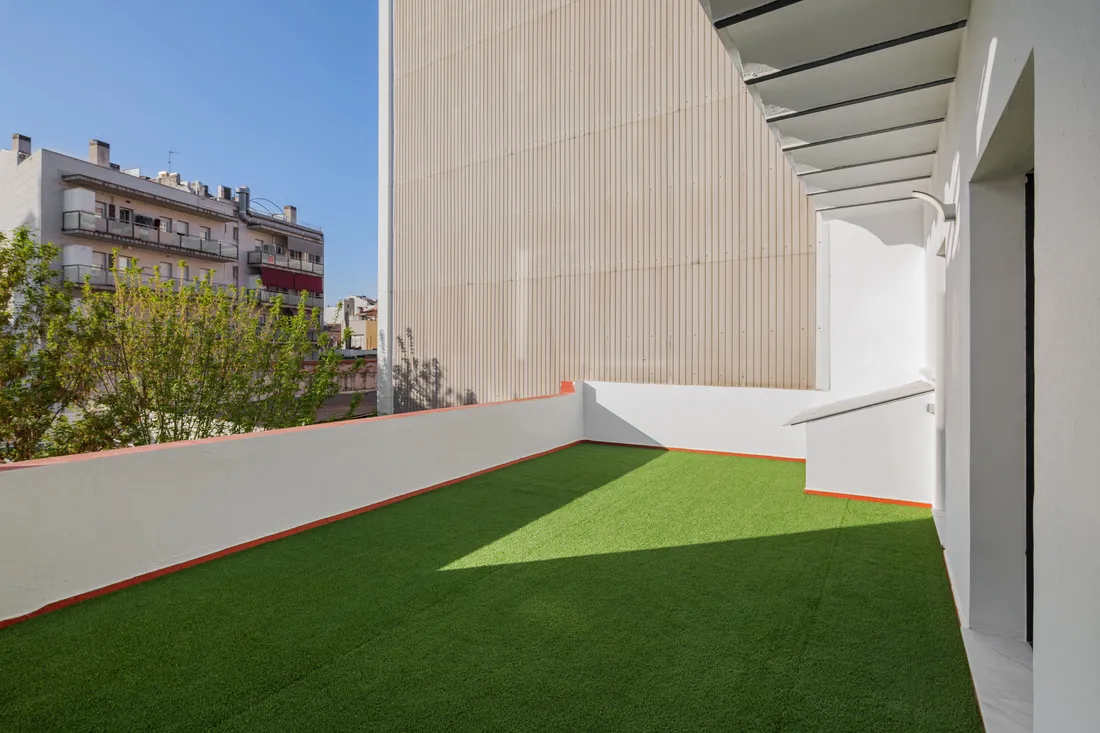
Balcony, terrace and rooftop questions from Sydney apartment owners
Does my owners corporation have to approve artificial grass on my balcony?
Assume yes until someone in writing tells you otherwise. Most Sydney apartments sit in a strata scheme under NSW law, and a balcony is commonly either common property or subject to scheme by-laws that cover alterations, floor coverings and anything sitting over the building's waterproofing. What those by-laws actually say varies from building to building, so we cannot tell you your answer, only where to get it: your strata managing agent, your building manager, or the registered by-laws for your scheme. Ask before you order anything and keep the reply. If you rent, you need your landlord's written consent as well, which is a separate permission again.
Can turf be laid on a balcony without drilling anything?
It has to be, and that is the defining constraint of the whole job. Below your tiles or bare screed sits the waterproofing that keeps rain out of the unit underneath. Pegs, nails, plugs and screw-fixed edge trims all create a route through it, and a route through waterproofing eventually finds water. Balcony turf is instead restrained at its perimeter, either bonded with an adhesive rated for use over the existing surface, tucked beneath a threshold or an existing fixed edge, or held by the weight of the build up itself. If an installer reaches for a hammer drill on your balcony, that is the moment to stop the job.
What happens to the balcony's drainage once grass covers it?
Nothing should change about where the water ends up. Your balcony was built with a slight fall towards a floor waste or an edge outlet, and the turf has to work with that, not over the top of it. Turf backing is perforated so rain passes straight through, with the Australian baseline drainage specification sitting around 30 litres per square metre per hour. The catch is what happens next: water still has to travel sideways across the slab to reach the outlet, so a sheet laid flat onto the deck can hold moisture against the surface instead of letting it run. Drainage cells or a raised mat create the shallow gap that keeps that path open, and the outlet itself must stay visible and reachable.
How hot will it get on a west facing balcony in a Sydney summer?
Hotter than living grass, and a west facing balcony with nothing above it is close to the worst case there is. Western Sydney University researcher Dr Sebastian Pfautsch has reported very high surface temperatures on unshaded synthetic turf, and a balcony removes the one thing that moderates it at ground level, which is soil holding moisture underneath. Instead you have a concrete slab and masonry that soak up sun all day, plus glass balustrades and neighbouring windows bouncing more of it back onto the surface. Manufacturers including TigerTurf point to shade, a hose down before use and lighter coloured yarn as the practical levers. Where a supplier attaches a percentage cooler figure to a product, treat it as that supplier's claim and ask to see the testing behind it.
Is the turf going to lift in strong wind on a high floor?
It can, if the perimeter is not properly held. Wind around a tower behaves nothing like wind in a fenced back yard, and Sydney gets its share of strong southerly changes and sustained coastal easterlies that hit an exposed balcony square on. Anything that offers wind an edge to get under is at risk, and the failure is always at the perimeter or an untreated join, never in the middle of the sheet. Ask any installer to explain in plain terms how they are restraining the edges given they cannot drill, and treat a vague answer as a warning. A sheet of turf leaving a tenth floor balcony is a safety issue, not an inconvenience.
How much weight does balcony turf add?
The turf itself is comparatively light and a drainage layer adds a little, but sand infill is far and away the heaviest part of the build up, with the standard dressing rate for a lawn sitting at roughly 10 to 15 kilograms for every square metre. We will not publish a safe loading figure for your balcony, and you should be wary of any turf website that does, because capacity depends on the individual structure, its age and whether you are standing on a cantilevered balcony, a podium terrace or a rooftop over habitable rooms. Your building's documentation, the owners corporation, or a qualified professional such as a structural engineer are the right places to ask. On a compact apartment balcony with a thin build up it is usually a small question. On a large terrace or a rooftop it is a real one.
Should I use sand infill up there?
It is a judgement call rather than a rule. Sand ballasts the sheet and props the blades upright, so leaving it out means accepting a flatter, more carpet like look sooner and leaning entirely on the edge restraint to keep everything in place. Against that, sand adds the weight discussed above and has a habit of finding its way inside on bare feet, which people notice much more in an apartment than in a house. A shorter, denser pile copes better with reduced infill than a long soft landscape grass does, and landscape products generally run 30 to 45mm, so the shorter end of that band usually suits a balcony better. Decide it deliberately with your installer rather than letting it happen by default.
What does a balcony job cost per square metre in Sydney?
Published Australian supplier pricing puts balcony and rooftop work at about $90 to $150 per square metre, against roughly $85 to $140 for general residential work at ground level. People are often surprised the small job carries the higher rate, but the base building that normally accounts for around 30 per cent of a lawn install has simply been swapped for protecting waterproofing, building a drainage layer, carrying materials up in a lift and spreading the fixed cost of turning up across very few square metres. Those are indicative figures drawn from published Australian supplier and industry data. They are for budgeting, not a quote.
Does artificial grass on a balcony get me around Sydney's watering rules, or any rebate?
There is no rebate. No council, water utility or state government anywhere in Australia pays you to replace lawn with synthetic turf, and any page implying otherwise is simply wrong. What does apply is Sydney Water's permanent water wise guidelines: lawns and gardens may only be watered with drinking water before 10am or after 4pm, hosing down hard surfaces is not allowed, and fines run to $220 for an individual. Newly laid natural turf gets a 28 day exemption from those hours. Synthetic grass sidesteps the watering question entirely, which on a balcony full of pots is a modest saving rather than a dramatic one. Be honest with yourself about that before it becomes the reason you buy.
Can I take it with me when I move out?
Often yes, and it is worth designing for from the start if you are renting or expect to sell within a few years. An installation that sits loose over a drainage layer and is restrained at its edges can usually be lifted, rolled and taken, and it leaves the balcony surface as it was found, which is also the version an owners corporation tends to be most comfortable approving because it can be pulled up for inspection. A fully bonded installation is a different proposition and removal is a bigger job. Say up front which of the two you want, because it changes both the method and the price.
Get a price for your balcony, terrace or rooftop
Free, no obligation, and no sales list. Tell us the size, the floor it is on and how materials would get up there, and one vetted local installer confirms an exact price after seeing the space.
Get a free, no-obligation quote
Tell us a little about your job and we'll pass it to a vetted local installer.